
Around the Kitchen Table
the people who taught me what belonging looks like

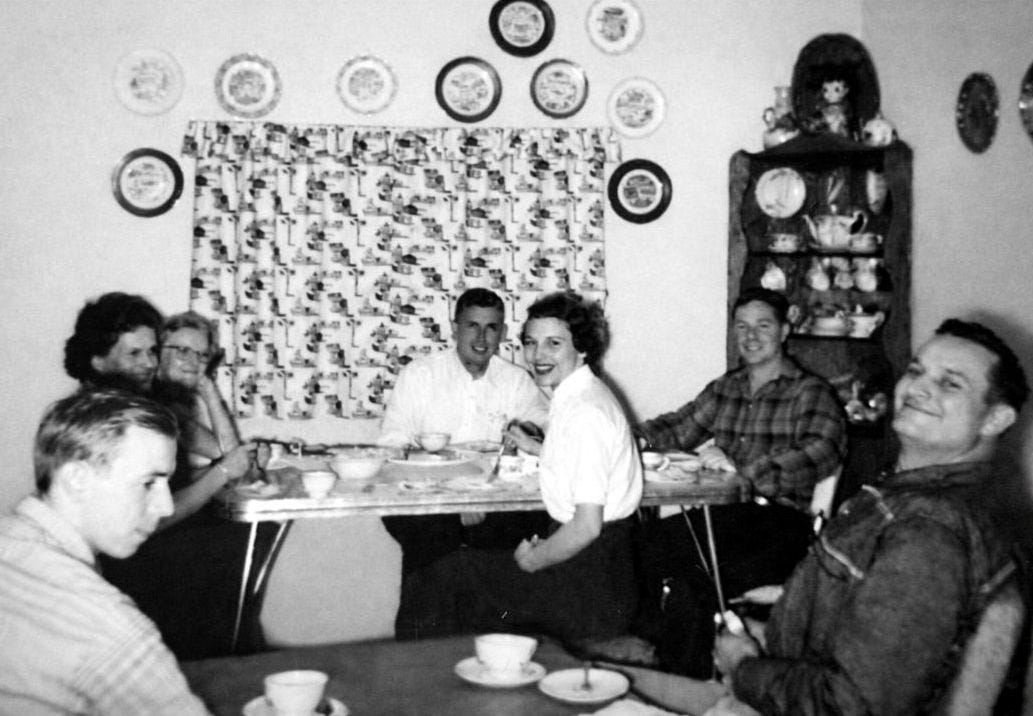
I found this photograph while sorting through the thousands of pictures in my parents’ home — a small square of time from an ordinary night. Coffee cups sat on the table, plates pushed slightly back, and a kitchen full of people who belonged there, as comfortable as if they were in their own kitchens. Just a simple gathering of friends in my mama’s kitchen while the kids were outside playing ball or a game they made up on the fly. There’s nothing about it that suggests this was a special occasion. An ordinary night to them, but extraordinary to me.
My mother isn’t in the frame. She must have been the one holding the camera, standing slightly back from the table, observing more than participating in that moment — preserving it without interrupting it. I’m grateful she took those few seconds to freeze that moment in time. Everyone looks relaxed, and I can almost hear their voices echoing across the years. Based on the familiar faces in the frame, I believe this was taken around the time I was born.
The people gathered there were my parents’ peers, but they were never just casual friends. They were the ones who showed up on ordinary nights, not for holidays or milestones, but because that’s where they knew they were welcomed. They shared meals, stories, card games, worries, and laughter around that table. Their presence made the kitchen feel full even when the cupboards weren’t. Long before I understood what community meant, I was being raised inside it.
The man in the foreground on the right was the steady rock of the group — the voice of reason. Everyone loved his stories. The only times I remember him without a cup of coffee nearby were during church services. Through many trying moments in my young adult life, I turned to him for advice. He never let me down.
He worked at the steel plant with my dad. When the plant went on strike — always in August, when timing was cruelest — he and my dad, along with his wife and my mother, picked cotton so there would be school clothes for the kids. That kind of thing didn’t require a meeting or a discussion. It was just understood. Work needed doing, children needed shoes, and everyone did their part.
His wife, on the left and partially obscured in the picture, attended school with my dad. They were lifelong friends in the truest sense of the word — the kind that allows for disagreements. Sometimes those disagreements were loud. They argued like brothers and sisters, but after a few days the dust would settle and they’d be as they were before -- until the next time. It was part of their ebb and flow, and everyone accepted it as normal when strong personalities collided.
She worked long hours at the Goodyear Tire Plant. She knew what a full day’s work felt like and continued to show up day after day. On Sundays for many years, she was my Sunday School teacher. When my older sister became very ill and my parents were overwhelmed in ways I didn’t yet understand, she was the one I gravitated toward during those messy adolescent years.
My dad sits in the background on the right. These were his people. I can tell by the look on his face that he’s enjoying the evening.
The man in the center was a fireman, a butcher, and a cabinet maker — a combination that made perfect sense if you knew him. He built things that lasted and showed up when things went wrong.
His wife sits front and center in the photograph. She had red hair and a presence that filled whatever space she entered. If there was laughter in the room, it usually started with her. If there was a party, she was already in the middle of it. And if I got into mischief and received The Look from my mama, I knew I could find a safe spot with her.
The lady in the back left was soft-spoken and kind. Her husband, in the left foreground, was a house painter and mechanic. They were simply “good people” -- and that speaks volumes.
Looking at the photo now, what I see isn’t just a gathering. It’s a network before such a thing was named. A safety net. A chosen family built out of shared work, shared faith, shared summer trips to the beach, and an unspoken agreement that no one was raising children alone. Every child in those families knew that every parent in the group had permission to correct and call out rowdy behavior.
They stood in for one another when work was hard, money was tight, or life took a turn no one expected.
I was the baby of all their children, which meant I was watched over, occasionally spoiled, corrected, fed, and claimed.
They didn’t just sit around the kitchen table. They built a life there — one that made room for all of us. And long before I knew how to name it, I understood this much: I belonged. Even though seven other kids preceded me to the party, I belonged there just as much as they did.
What strikes me now is how vibrant they all were, here in their prime before time and life began to leave their marks.
Their personalities were different — strong opinions, steadfast words, sharp humor, stubborn streaks, soft hearts — but somehow they balanced each other. They argued, laughed loud, worked hard, showed up, and built a life together around kitchen tables, church pews, beach houses, and ordinary days that turned out not to be ordinary at all.
Every one of them is gone now.
I’ve said this before and still believe it: as long as someone remembers you — tells your stories, cooks your recipes, laughs at the old jokes — you’re not really gone.
They taught me, without ever saying a word, how lives are built and shared.
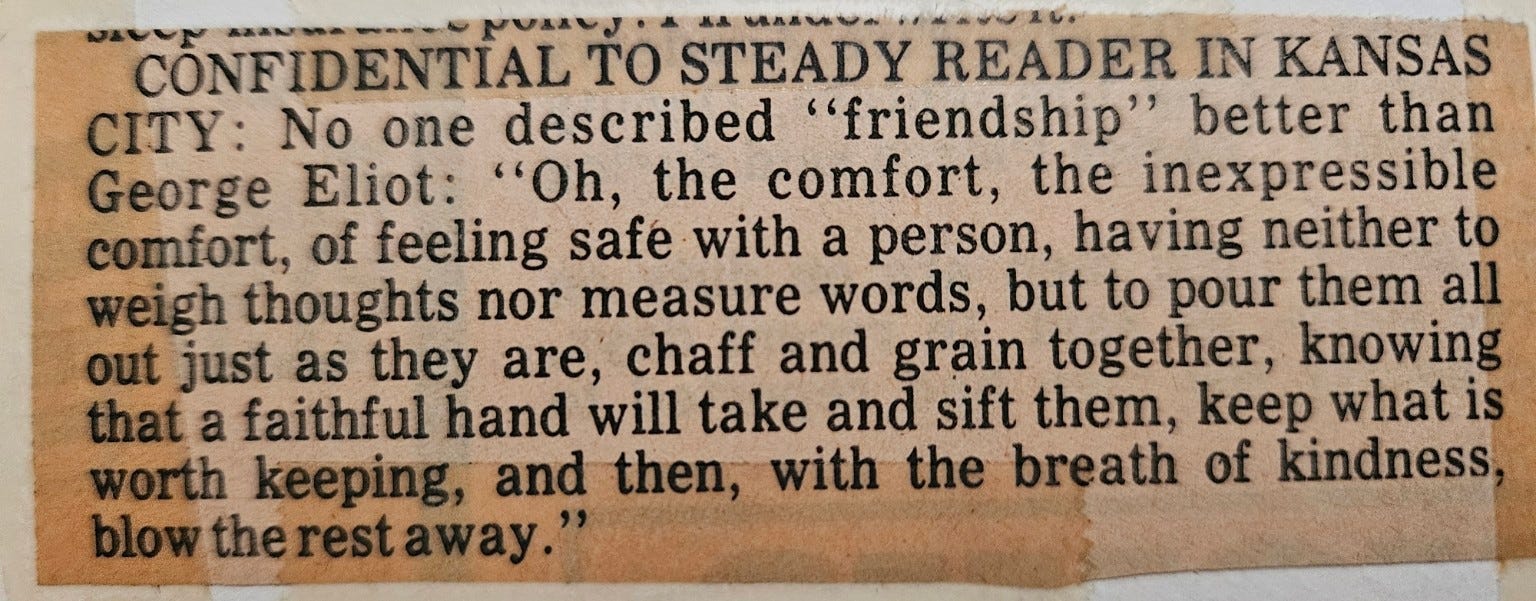
A few days after I finished writing this article, I came across this yellowed newspaper clipping that my mother had taped inside the cover of her Bible. I think she would agree with the words I wrote.
Maybe just to old Lookout Mt guys(me) a name or two would add to my enjoyment.